Free, sourced and yours to keep. Across this belt, the thing that decides what belongs on your windows is not your suburb's name — it is how far your street sits above the sea, and the fact that there is no mountain up here big enough to end the afternoon early.
Read it, use it, and only call us if it helps. The measure is free either way.
People move up here from the other side of the N1 and expect their windows to behave the way they always did. They do not, and the reason is a single missing landform.
Table Mountain stands at 1 086 metres.1 Sit a house at its foot and the sun disappears behind a wall of sandstone long before the almanac says sunset — which is why the old southern-suburbs houses are full of pale fabric and lamps. Our hill does no such favour. The Tygerberg's summit is about 415 metres,2 a quarter of the height, and for most of this belt it sits to the north or east of you rather than in the path of the setting sun.
So the arithmetic runs the other way. On the December solstice the Cape Town sun crosses noon at about 75 degrees, then works its way down to a sunset bearing of roughly 240 degrees — south of due west — and does not go under until 19:57.3 Nothing intervenes. A west or south-west facade in Durbanville, Plattekloof or Welgemoed takes that beam from mid-afternoon until nearly eight at night, with the glass getting hotter the whole way.
Down there the mountain switches the sun off for you. Up here you have to do it yourself, and you have to do it on the outside of the glass.
The one sentence this whole guide is built on
That is why almost every serious answer in this guide ends up mounted outside the pane rather than behind it. It is not an upsell; it is thermodynamics. Any fabric hanging on the room side of the glass can only intercept heat that has already come through — the pane warms, the fabric warms, and both of them radiate into the room for the rest of the evening. Stop the beam before it touches the glass and the pane never loads up in the first place.
80 m
Eighty metres: the Bellville floor
Bellville averages about 80 metres above sea level and sits in the trough between the low Cape Flats to the south and the Tygerberg rising to the north.4 Down on that floor the streets are older and more closely built, the trees have had forty years to get tall, and your neighbour's roof is doing more shading work than you realise.
Two practical consequences. First, wind exposure here is genuinely milder than it is three kilometres uphill, which widens what you can hang outside — a folding-arm awning over a patio is a straightforward proposition at this height in a way it is not on the ridge. Second, the shading you actually need is often partial and low down: the four o'clock beam arriving under a neighbouring roofline or through a gap between two houses, hitting one specific chair.
For that, an interior sunscreen roller is usually enough and usually the right money. A mesh of around three to five per cent openness cuts the glare and the UV without turning the room into a cave, and it keeps whatever view the street gives you. Where the room also needs to go properly dark, put the second fabric on the same bracket rather than buying a second window treatment: a double roller carries blockout behind the mesh and you draw whichever the hour calls for.
100–240 m
A hundred to two hundred and forty: the Durbanville shelf
Durbanville sits roughly 28 kilometres north-east of the city centre, and its ground ranges from about 100 to 240 metres.5 The Durbanville Wine Valley — fifteen farms strung along the Tygerberg hills — is the reason so many lounges up here were built facing a direction nobody would have chosen for comfort. The valley's own marketing calls it Sauvignon Blanc country because the sea breezes off Table Bay and False Bay keep the vineyards cooler than the interior;5 the vines get the benefit, and your west-facing picture window gets the view.
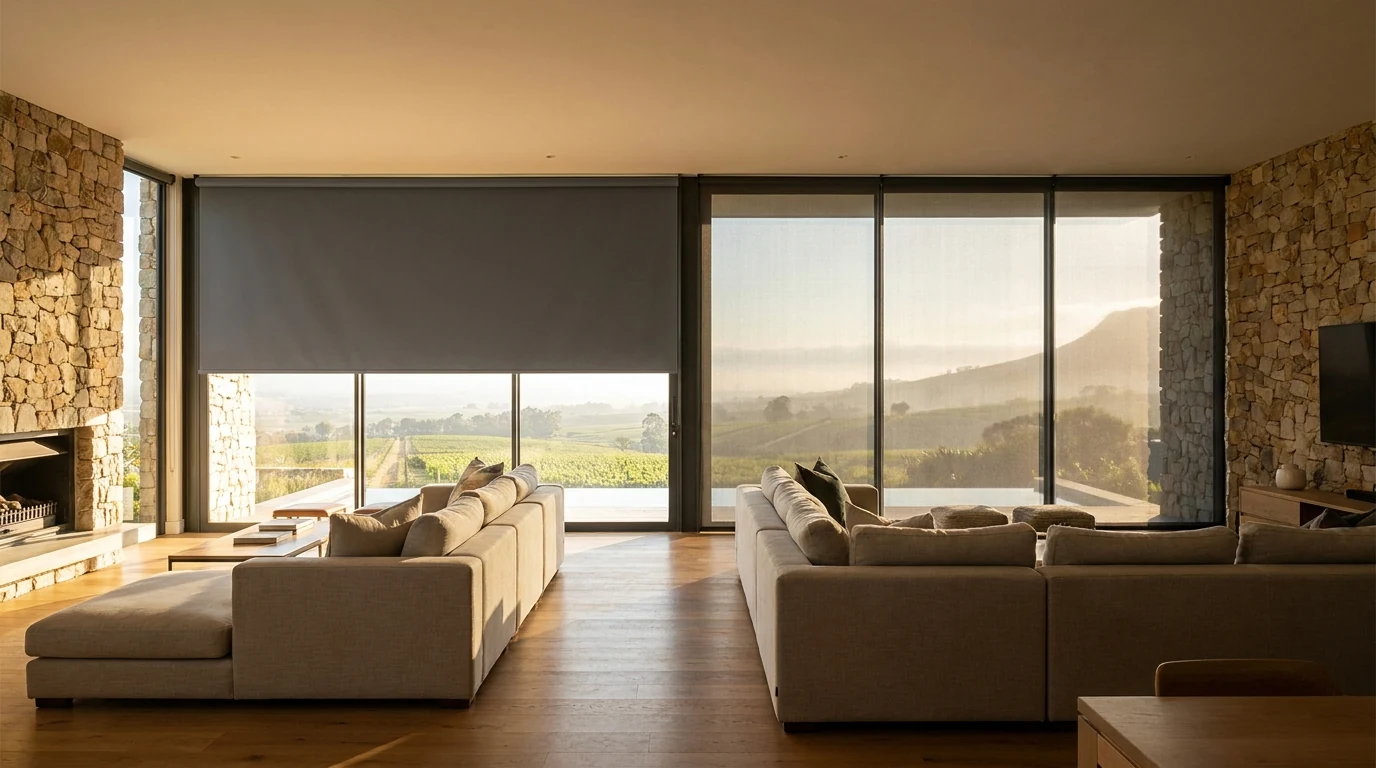
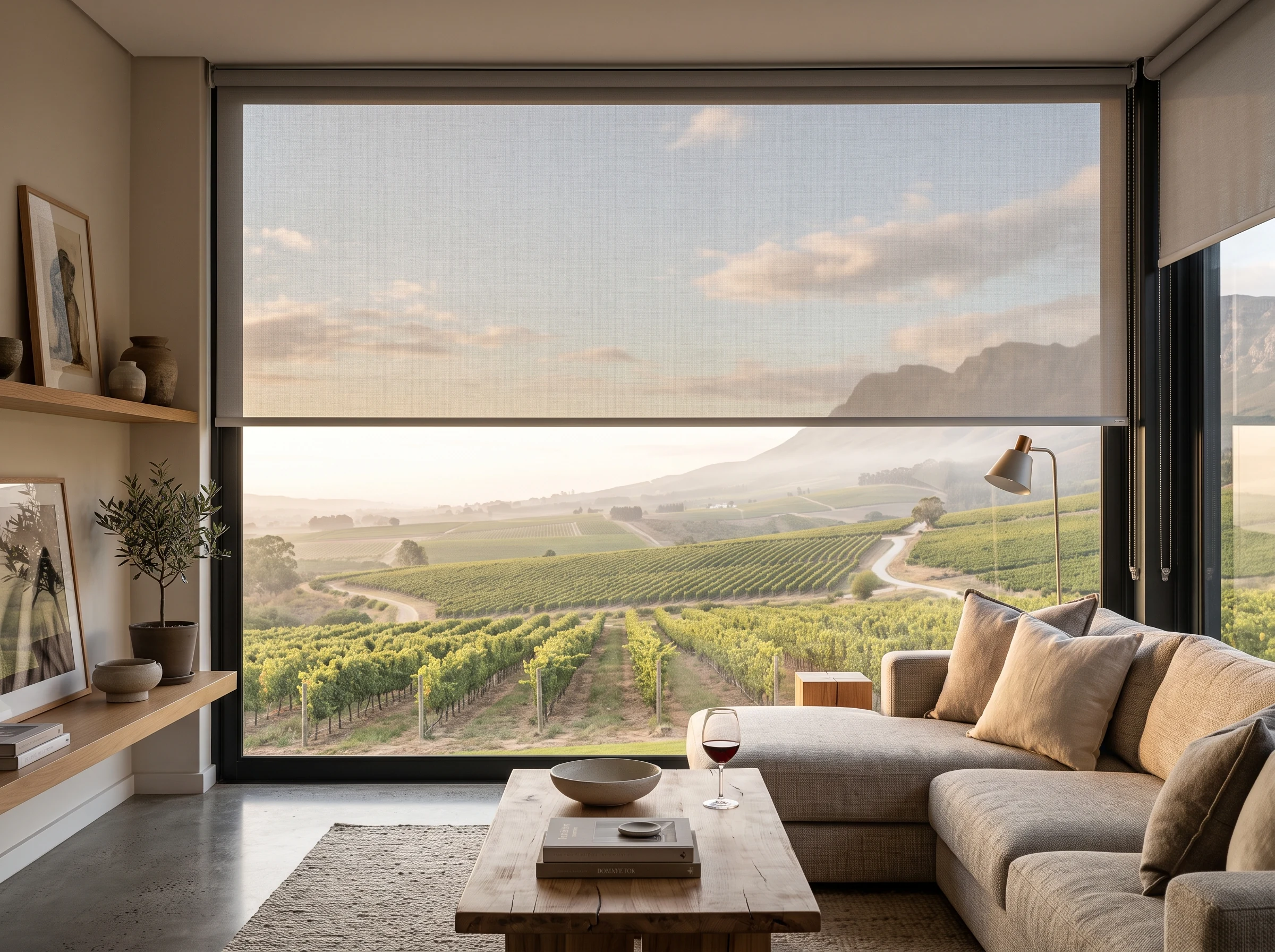
This is the single most common brief we take in the belt: a large, mostly frameless pane, put there deliberately to hold vineyard rows and the hillside behind them, and unusable from about three in the afternoon in February.
A Durbanville lounge with the mesh down: the vineyard rows still read through the weave, which is the whole test of whether a sunscreen fabric has been specified correctly.
Do not answer that window with something opaque. An opaque blind on a view pane throws away the reason the house was built facing that way — and it still lets the glass cook. The honest hierarchy on a shelf-level west window is:
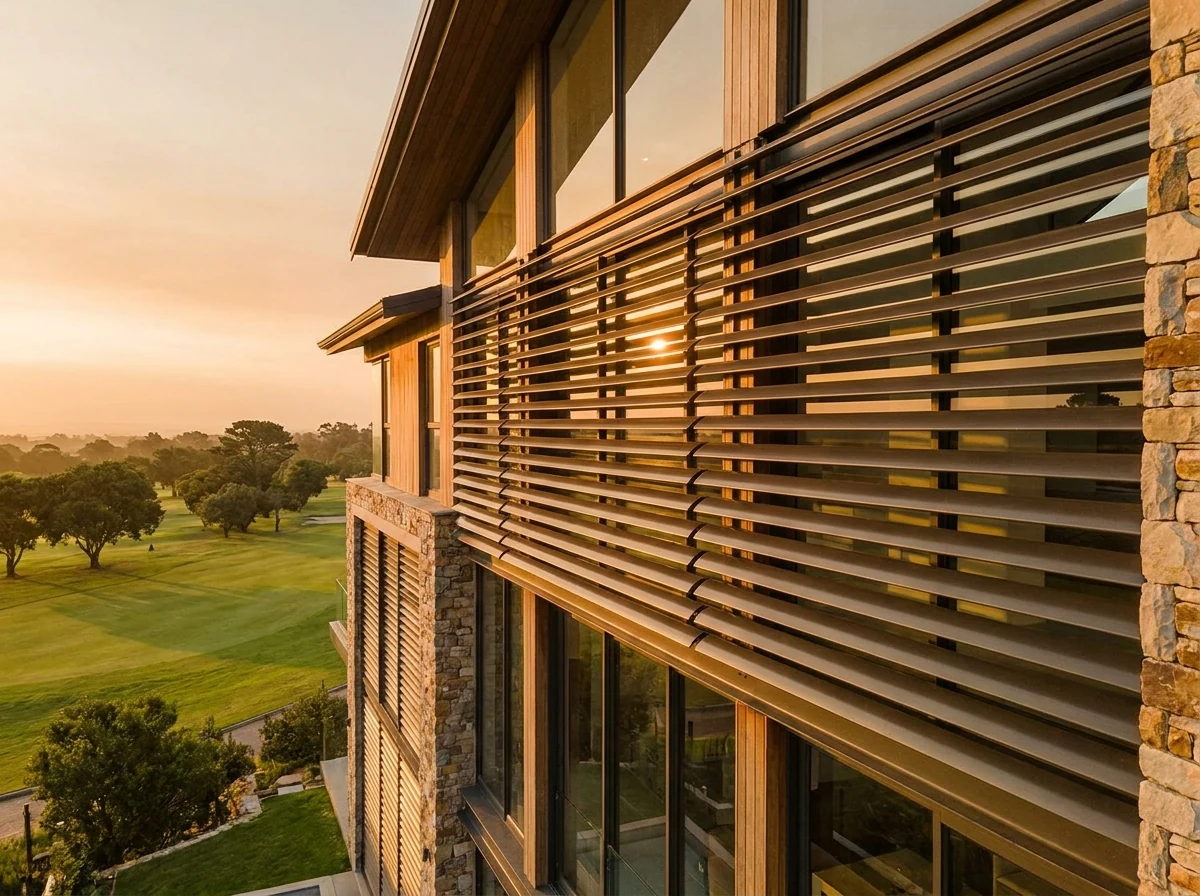
External venetian blinds — aluminium slats outside the pane that raise and tilt, so you can kill the low beam while keeping a horizontal slice of vineyard. Best-performing answer there is.
Zip screens — tensioned mesh running in side channels outside the glass, which is the cheaper external route and holds its shape in wind.
Interior sunscreen — the fallback when nothing may be fixed outside. It fixes glare and UV, it does noticeably less for heat, and we would rather say so than sell it as equivalent.
Newer Durbanville estate homes arrive at handover with bare glass and a double-volume void, and the temptation is to cover everything at once with the cheapest thing that fits. Do the west elevation properly and leave the south side for next year. One good external product beats five interior compromises.
310 m
Three hundred and ten: the highest street in the city
Welgemoed lies on the Tygerberg's slopes at about 310 metres — the highest suburb in Cape Town — looking out over Bellville and the wider metro.6 Everything gets more extreme at that height. More sun-hours on the glass, less shelter from anything, and a great deal more wind.
Wind is the deciding factor in what may be specified up here, and it is worth being blunt about it. Spring and summer in Cape Town belong to the south-easter — the Cape Doctor, generated by the South Atlantic high — and on an exposed ridge-top stand it arrives with nothing in its way.7 Fabric that is fine on the valley floor is a liability at 310 metres unless it is either rigid, tensioned, or able to get itself out of trouble.
West-facing Welgemoed glass with external venetians fitted: the slats intercept the beam a hand's width in front of the pane, which is the only place it can be stopped for good.
What we would put on a ridge-top west wall
External venetian blinds, motorised, with a wind sensor. The slats do the shading; the sensor does the surviving. It lifts the blind into its headbox when the anemometer says so, which on this ridge will be several afternoons a month between October and March. Ask for the product's rated wind class in writing — it is a number, not an adjective.
External roller shutters where the room wants more than shade. Rigid aluminium slats roll down over the glass from a headbox, cut heat and glare hard, damp road and wind noise, and leave a still-air gap that helps on cold winter nights too. To be plain: these are a shading product for sun, heat and glare. They are not a security-rated item — that is a heavier, different specification we can quote separately.
Zip screens for a stoep or braai area. Because the mesh runs under tension in channels top to bottom, it holds in a gust that would fold an unsupported arm, and it turns an exposed terrace into somewhere you can actually sit at six on a windy evening.
The honest caveat: all three bolt to the building. That means a wall that can take the fixing, a bit more money, and — in several of this belt's gated streets and newer estates — a committee that wants to see the product before it goes up. We check that at the measure rather than guess.
415 m
Four hundred and fifteen: renosterveld and the top of the hill
The top of the belt is not houses at all. The Tygerberg Nature Reserve covers around 300 hectares of the hills above Bellville, was proclaimed in 1973, carries thirteen kilometres of walking trails and protects critically endangered Swartland shale renosterveld.8 The range has been named for its cats since at least 1657, when it was recorded as the Luipaerts Berghen.8
If your stand backs onto it or looks up at it, two things follow for your windows. The first is dust: a dry veld slope above you in February means fine grit on every horizontal surface, which argues for wipe-clean aluminium and for fabrics you can vacuum rather than delicate weaves in the rooms on that side.
The second is fire season. Renosterveld is a fire-driven vegetation type, and living against a reserve boundary in a dry Cape summer is not an abstract risk. Nothing we fit is a fire product and we would not pretend otherwise — but it does change one specification. Any outdoor fabric on that side of the house should be retractable and actually retracted: a folding-arm awning that winds fully into a closed cassette, ideally on a motor so nobody has to be home to do it. Fabric permanently extended on a boundary facing dry veld is the wrong call for several reasons at once.
Inland
Twenty-odd kilometres from the sea, and what that swaps out
Bellville is about 23 kilometres from the city centre and Durbanville about 28,45 which puts this whole belt well back from the Atlantic. Two swaps follow.
Out goes salt, in comes heat and UV
On the seaboard, hardware specification is dominated by airborne salt. Here it simply is not the driver. What replaces it is thermal load and ultraviolet: Cape Town's climate is classed hot-summer Mediterranean, the city sees roughly 3 100 hours of sunshine a year, and summer averages a daily maximum around 26 °C before you count the days when the berg wind pushes hot dry air down off the Karoo interior and the whole belt sits well above that.9 So we specify for UV stability, colour-fastness and heat, not marine-grade fixings — and on a west wall we specify for the beam being stopped outside.
Out goes the rain, and with it a lot of anxiety
The other swap is water. The city's own long-run rainfall average is about 515 mm a year, while the southern suburbs tucked under the mountains average closer to 1 000 mm.9 This belt lives at the drier end of that. Practically, it means damp-related worries that dominate a specification on the wet side of town — chronic condensation, mould behind fabric, timber taking up moisture — are far less of a factor here. Timber venetian slats, which we would refuse to put in a wet-side bathroom, are perfectly reasonable in most rooms of a Northern Suburbs house.
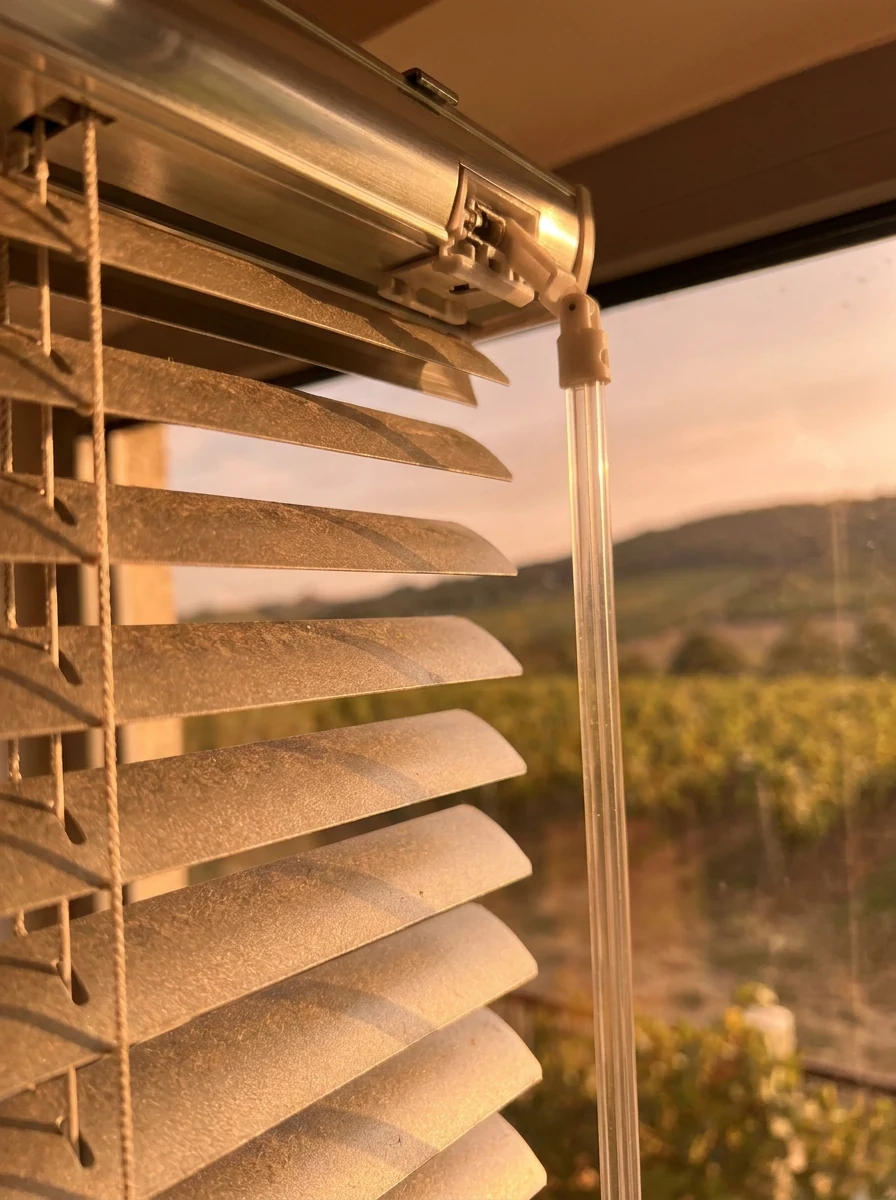
Slat and tilt wand at close range. Aluminium in the wet rooms and the dusty rooms; timber where the room stays dry and you want the warmth.Priorities
Spending the budget in the right rooms
Very few households do the whole house at once, so here is the order we would put the money in on a typical Tygerberg-belt home. It is a general order, not a rule; your house may swap two of them around.
The west or south-west living glass. This is the room that is unusable in summer and the only one where external shading genuinely pays for itself. Everything else is comfort; this is the fix.
Bedrooms that face east. At midsummer the sun is up before half past five,3 and no fabric on earth makes a room dark if light is coming around the edges. Darkness is a fitting question before it is a fabric question: over the opening rather than inside the reveal, with side channels if you are serious.
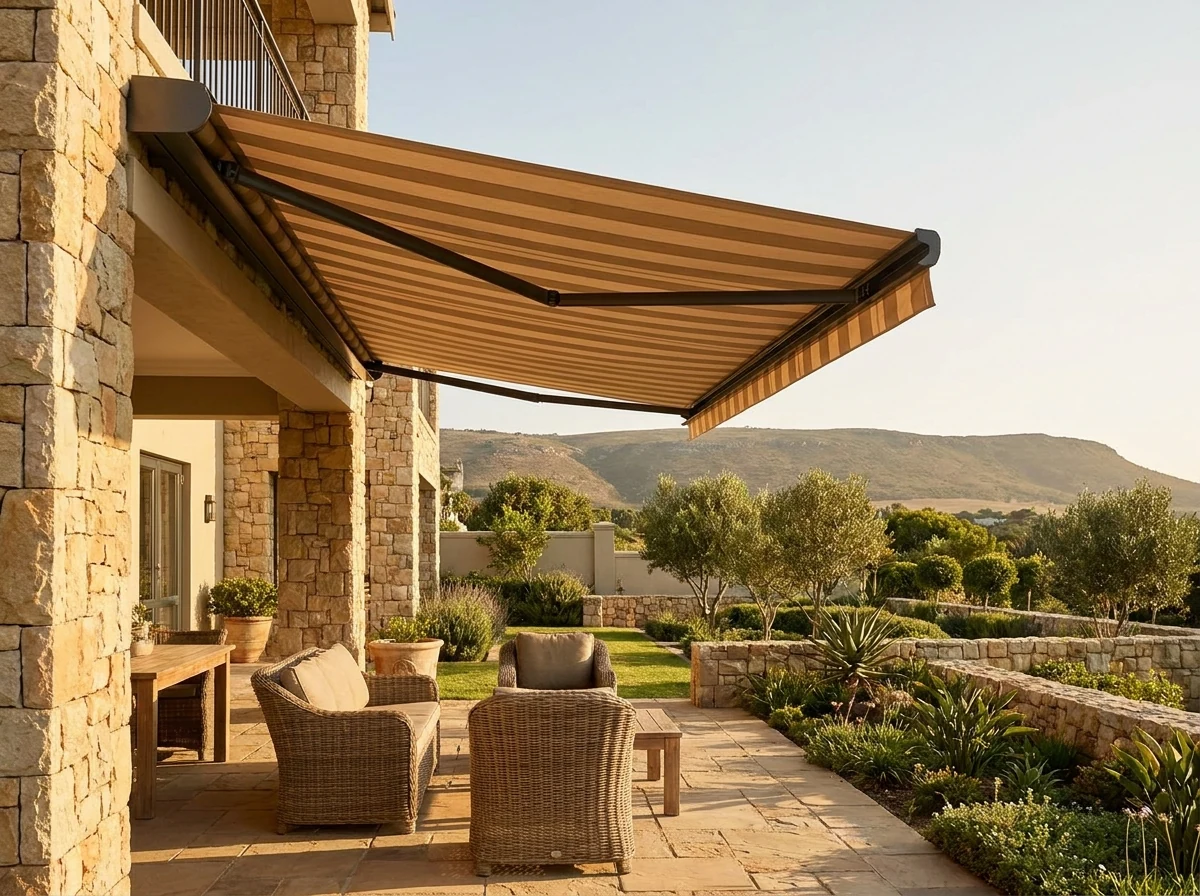
The stoep, patio or braai side. A folding-arm awning turns an unusable slab into the room you live in from November to March. Motorised with a wind sensor if you are above the valley floor.
North glass. High summer sun, so a modest projection outside does a lot; and in winter you want that low sun let in, which is the argument for anything adjustable rather than fixed.
Everything south. Privacy, softness and finish rather than heat. This is where a day-night banded blind earns its keep, or a plain roller in a good colour.
A folding-arm awning out over a Kanonberg patio. The cassette is the part that matters up here — fabric that rolls away clean is fabric that is still there in five years.
One more thing on motors, because this belt asks about them more than most. Motorisation is not a luxury item on a west elevation; it is the mechanism that makes external shading work. Nobody remembers to lower a blind at 15:40 every day in January, and nobody is home to raise it before a gust. A sun sensor and a wind sensor do both, reliably, and they are the difference between a product that performs and one that sits in its box looking expensive.
On site
The five things a tape measure has to find
Everything above comes off maps, almanacs and published climate records. These five do not, and they are the reason the measure is free and unhurried rather than a sales call in a polo shirt.
True orientation, not remembered orientation. Almost everyone tells us their lounge faces west. A compass on the sill settles it in three seconds, and "south-west" versus "west" changes the product.
What the wall is made of. Brick, cavity, lightweight infill or cladding decides whether anything external can be carried at all, and what the fixing has to be.
The real wind exposure of that specific facade. A ridge address does not automatically mean a hammering — a screen of neighbouring houses or a mature stand of trees changes it, and it decides the wind class we quote.
Whether your street has an architectural committee. Several gated pockets and newer estates in this belt do, and they take a view on anything visible from outside. We establish that before quoting, not after delivery.
Power and reach. Whether a motor has a circuit near it, whether a battery tube can be charged without a ladder in a double-volume void, and where a hard-wired sensor can sensibly live.
None of the five is expensive to check beforehand. All five are expensive to discover afterwards.
Next step
Bring the guide, we'll bring the samples.
A free in-home measure, fabric and slat samples on the sill, and a written quote itemised per window — with an honest note on any window where an external product is the answer and an interior one is not.
Give us the room, roughly which way it faces and how high up your street sits. One of our expert consultants will contact you shortly to arrange your free in-home measure.
Free measure, free samples, no obligation to order
We'll tell you where an interior blind is genuinely enough
Written, itemised quote before anything is ordered
Sources
Where these figures come from
Every measurement, date and climate figure above traces to one of the references below. The product recommendations are our own opinion and are given free and without obligation.
Wikipedia — Table Mountain (highest point 1 086 m, used here only as the contrast against the Tygerberg).
PeakVisor — Tygerberg (summit elevation about 415 m).
Gaisma — Cape Town sun and moon data (December-solstice altitude at 12:00 about 75°, sunrise 05:32, sunset 19:57 on a bearing of about 240°; June-solstice altitude at 12:00 about 31°). Cape Town is given at 33°55′S, which is within a few minutes of latitude of every suburb in this belt. Peak altitudes here come from the latitude and the ±23.44° solar declination; the source's figures above are for 12:00, not solar noon.
Wikipedia — Bellville, Western Cape (average altitude about 80 m, about 23 km north-east of Cape Town, sited between the low-lying Cape Flats to the south and the Tygerberg hills to the north).
Wikipedia — Durbanville (about 28 km north-east of the city, ground from roughly 100 m to 240 m; the Durbanville Wine Valley's fifteen farms along the Tygerberg hills, and the cooling influence of Table Bay and False Bay winds).
Wikipedia — Welgemoed, Bellville (about 310 m, the highest suburb of the city, overlooking Bellville and the greater metropolitan area).
Wikipedia — Cape Town, climate section (the south-easter, known locally as the Cape Doctor, blows in spring and summer and results from a high-pressure system over the South Atlantic).
Wikipedia — Tygerberg Nature Reserve (about 300 hectares above Bellville, established 1973, thirteen kilometres of trails, critically endangered Swartland shale renosterveld; the range recorded as Luipaerts Berghen in 1657).
Wikipedia — Cape Town, climate section (hot-summer Mediterranean classification; summer daily maximum averaging about 26 °C; roughly 3 100 hours of sunshine a year; city rainfall averaging about 515 mm against nearer 1 000 mm in the southern suburbs beneath the mountains; summer heat associated with the berg wind blowing from the Karoo interior).
Nothing on this page is an engineering opinion, a wind-load calculation or an estate-approval ruling. Wind ratings come from the manufacturer's test data for the specific product quoted, and approval for anything fixed to a facade always rests with your estate, body corporate or the City of Cape Town.